Overview
JLP Loans allows users to deposit their JLP tokens as collateral to borrow USDC, maintaining exposure to JLP yields while accessing liquidity. The lending feature implements an overcollateralized lending model with dynamic interest rates based on utilization for the borrowed token.
Key Parameters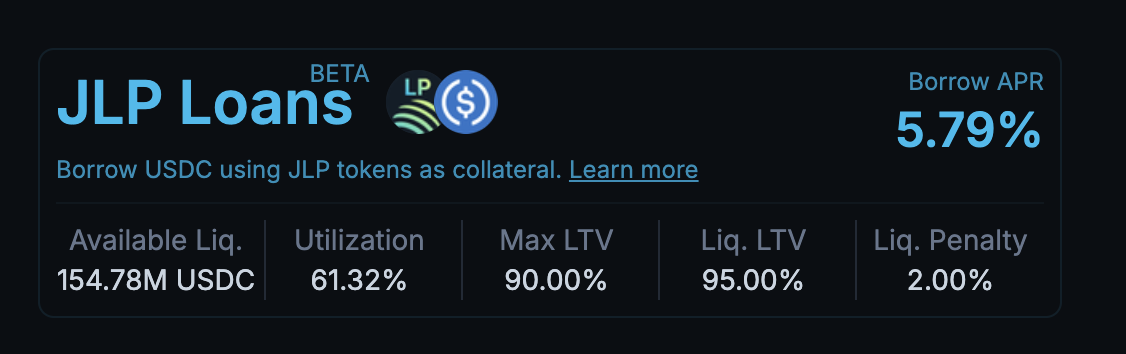
- Collateral: JLP
- Borrowable tokens: USDC
- Available liquidity: The amount of tokens available to borrow for the asset
- Utilization: Utilization (%) of the borrowed token (lower utilization = lower borrow APR)
- Maximum LTV: 90%
- Liquidation LTV: 95%
- Liquidation penalty: The penalty (%) applied on the position's collateral on liquidation
Position Management
Each user maintains a single lending position per custody, containing:
- My Collateral: JLP deposited as collateral
- My Debt: Outstanding debt (principal + accrued interest) in the borrowed token amount
- Liq. Price (JLP): The estimated JLP price at which the position will be liquidated
- LTV: The loan-to-value (LTV) ratio of the position
Loan-to-Value (LTV)
LTV Calculation
The loan-to-value (LTV) ratio represents the ratio between borrowed assets and collateral value:
LTV = (Outstanding Debt) / (JLP Collateral Value in USD)LTV Thresholds
The protocol enforces two critical LTV thresholds:
- Maximum LTV (90%): The maximum initial borrowing limit against deposited collateral
- Liquidation LTV (95%): The threshold at which positions become eligible for liquidation
Example Position
Consider a position with $10,000 worth of JLP deposited:
- Maximum initial borrow: $9,000 (90% LTV)
- Liquidation occurs if debt reaches: $9,500 (95% LTV)
- Recommended safe borrow: $6,500 (65% LTV)
Borrow Rate
The borrow APR shares the same interest rate curve used in the Jupiter Perpetuals protocol with different parameters specified in the borrowed token's custody account in jumpRateState and borrowsFundingRateState.
A higher borrow APR means users pay more interest rates to maintain their position, and vice versa.
Borrow APR calculation
NOTE: The code to calculate the borrow APR can be viewed here
The protocol calculates your borrow rate based on the pool's utilization:
1) Calculate pool utilization
Utilization = (Locked for Trading + Total Borrowed) / Total Pool Size
2) Calculate the owned and locked amounts for the custody
Read the JLP Economics page for more info on the total locked and owned values:
- Total owned: Pool assets + outstanding debt
- Total locked: Assets locked for collateral + outstanding debt
3) Calculate borrow rate
Utilization = (Total Locked × 10^9) / Total Owned
IF Utilization ≤ Target Utilization (80%):
// Linear increase when utilization < 80%
Rate Increase = (Target Rate - Min Rate) × Utilization / Target Utilization
Yearly Rate = (Min Rate + Rate Increase) × 10^9 / 10,000
ELSE:
// Jump rate curve when utilization > 80%
Rate Diff = Max Rate - Target Rate
Util Above Target = Utilization - Target Utilization
Remaining Capacity = 10^9 - Target Utilization
Extra Rate = (Rate Diff × Util Above Target) / Remaining Capacit
Yearly Rate = (Target Rate + Extra Rate) × 10^9 / 10,000
Hourly Rate = Yearly Rate / (24 × 365)
4) Convert to APR
Borrow APR = (Hourly Rate / 10^9) × 24 × 365 × 100
Liquidation Mechanism
JLP Loans uses a keeper-driven liquidation system with both partial and full liquidation paths to reduce unnecessary user losses while protecting protocol solvency.
Only whitelisted keepers are allowed to perform liquidations.
Liquidation Eligibility
A borrow position becomes eligible for liquidation when its Loan-to-Value (LTV) exceeds the Liquidation LTV threshold (95%).
To ensure timely execution, keepers may attempt liquidation slightly before the hard threshold using a small safety buffer.
Partial Liquidation
When a position exceeds the liquidation threshold but is not severely under-collateralized, the protocol performs a partial liquidation.
Partial liquidation:
-
Repays a portion of the outstanding debt
-
Burns only the required amount of JLP collateral
-
Brings the position back toward a safer LTV range
-
Allows the user to retain the remaining collateral and position
Partial liquidation is only executed when the position size exceeds a minimum liquidation size (to avoid dust liquidations and excessive overhead).
This mechanism:
-
Reduces forced full liquidation risk
-
Minimizes user losses during mild volatility
-
Improves overall capital efficiency
Full Liquidation (Extreme Conditions)
If a position becomes critically under-collateralized, a full liquidation is triggered.
A full liquidation may occur when:
-
The position’s LTV significantly exceeds the liquidation threshold (e.g. ~97%+)
-
Market volatility is extreme
-
Partial liquidation alone would be insufficient to restore solvency
Full liquidation:
-
Repays the entire outstanding debt
-
Burns the necessary amount of JLP collateral
-
Returns any remaining collateral (if any) to the user after fees
Liquidation Fee
A 2% liquidation fee is applied to the liquidated collateral.
-
The fee is deducted from the collateral burned
-
Fees are deposited back into the JLP pool as protocol revenue
Liquidation Summary
| Condition | Action |
|---|---|
| LTV < 95% | No liquidation |
| LTV ≥ 95% | Partial liquidation (if eligible) |
| LTV ≥ ~97% or extreme conditions | Partial + full liquidation |
| Liquidation fee | 2% of liquidated collateral |
User Protection
Users can avoid liquidation at any time by:
-
Depositing more JLP collateral
-
Repaying part or all of the outstanding debt
The partial liquidation mechanism is designed to give users multiple chances to recover their position before full liquidation occurs.
References
JLP Loans Initial Parameter Recommendations and Yield Projections